New to M-League? Check out our Beginner’s Guide to M-League!
What is M-League?
M-League (stylized M.LEAGUE, also written as M League) is a professional Japanese (Riichi) mahjong sports league. Created in 2018, M-League aims to change the negative gambling stereotype of mahjong and change it to a positive mind sport for everyone around the world. There are currently 9 different teams with 4 players each competing for the chance to win ¥50,000,000 and to be crowned the champions
What’s the format?
Regular Season:
Each of the 9 teams will play 96 games (216 games are played total). The score from each game is added to the team total.
Semifinals:
The top 6 teams from the regular season will have half their score carried over to the semifinals. Each team will then play 20 games each (30 games are played total).
Finals:
The top 4 teams from the regular season will have half their score carried over to the semifinals. Each team will then play 16 games. After all the games are completed, the champion will be declared.
I don’t understand Japanese. Can I still watch?
Of course! As long as you understand how to play riichi mahjong, you can watch M-League. I don’t know much Japanese myself, but I’m still writing this blog. Here’s a basic diagram of what to look for in the broadcast:
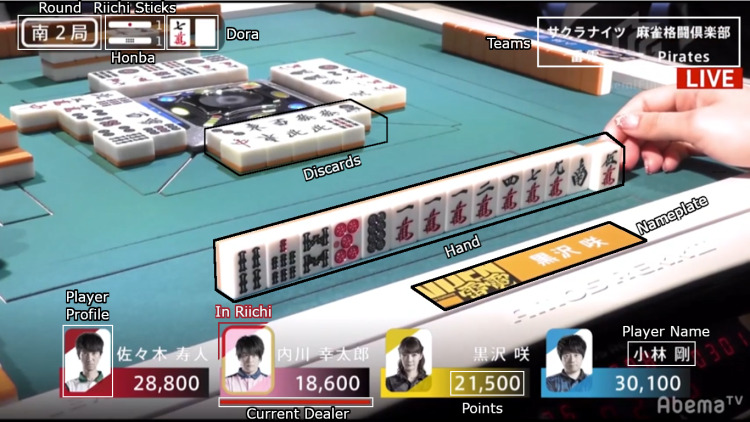
The above image is out of date. An updated image and article will be provided at a later date.
For more in-depth detail on the layout, please read Reading the M-League Interface.
For any terminology that is specific to M-League, please check the M-League Dictionary.
Where can I watch it?
Live games are shown on AbemaTV at https://abema.tv/now-on-air/mahjong.
What’s the schedule?
The entire season usually lasts from mid to late September to around May. The 216-game regular season starts mid to late September or early October, going through until the end March. The 30-game semifinals start shortly after that, and the 16-game finals start after that.
What are the rules?
The basic rules are as followed:
- Hanchan
- Kuitan ari, aka ari
- 25000 start
- 30/10 uma, 20k oka
- Renhou, nagashi mangan, optional yaku nashi
- Atamahane ari
- Kiriage mangan ari
A full list of rules can be found here: http://ooyamaneko.net/mahjong/rratw/index.php
Why are they taking the winning tile? Isn’t that bad manners?
In many places, it is bad manners to take the winning tile since there is a chance for cheating. However, M-Leaguers take the winning tile in order for the viewers to conveniently see the winning hand along with the winning tile. In short, they do it for TV.
So which team should I follow?
It’s up to you! Whether you like the players, like their sponsors, or just like their team colours, it’s totally your choice.
Who is the best player?
Because there is an element of luck in mahjong, it’s very difficult to determine who is the true best player. Some players that are often quoted as the best are Mizuhara Akina, Date Arisa, Ooi Takaharu and Sasaki Hisato, though the other players can be considered the best as well.
The player names are in the wrong order!
This is a matter of preference in terms of name order. I prefer to keep it in the Japanese name order (family name, then given name) since that is what you’ll hear and see most often in the broadcast. It’s also to try to follow Japan’s Ministry of Education, Culture, Sports, Science and Technology’s decision to keep the traditional Japanese name order in English official documents. (M-League style guide coming soon)
 M-League Watch