NOTE: The article below is out of date. There have been a few changes made to the M-League in recent years, but a lot of the basic information remains unchanged. An updated article will be made at a later date.
When you watch M-League, there are a lot of things shown on screen. Understanding just what’s going on in the game can be a challenge, let alone understanding the overlay. Here’s a guide on how to understand and read the overlay put on during the AbemaTV broadcast.
Diagram
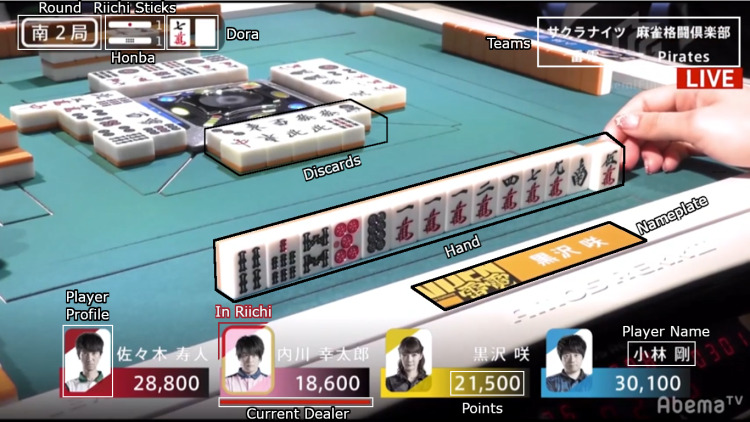
Top-Left Corner
Round
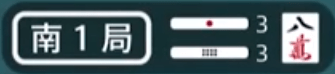
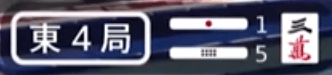
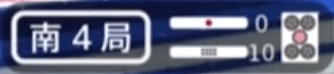
On the left side, you will see something like (南4局) or (東1局). The first character indicates what the round wind is. It will either be 東 (East) or 南 (South). The number indicates how far into the round the game is (to show whether it’s the 1st, 2nd, 3rd or 4th dealer). The character 局 is the Japanese character for round. Typically, you will see it shortened to E1-# or S1-# in articles, with the letter indicating the round and the number immediately after indicating the round (the # will be explained a bit later)
Riichi Sticks (Riibou)
The number to the right of the stick with one dot is the number of riichi sticks that were left over from the previous round. The next player who wins a hand will also take these sticks.
Honba
The number to the right of the stick with 8 dots on it is the number of honba (sometimes referred to as continuance counters or simply counters in English). Honba are counters which add 300 additional points to to the player who wins. Honba is increased every time the dealer wins or the hand ends in a draw. In English notation, it will be shown as the after the round. For example, S1-2 indicates it’s South 1 with 2 honba.
Dora


Right: Dora are 4s, 7s, 5s
The tile shown on the screen is the actual dora, not the dora indicator. If there are any kandora, they are also shown here. The dora adds 1 han to the winning hand, but doesn’t count towards the yaku requirement.
https://abema.tv/video/episode/444-4_s30_p519
Player’s Hand
Tiles
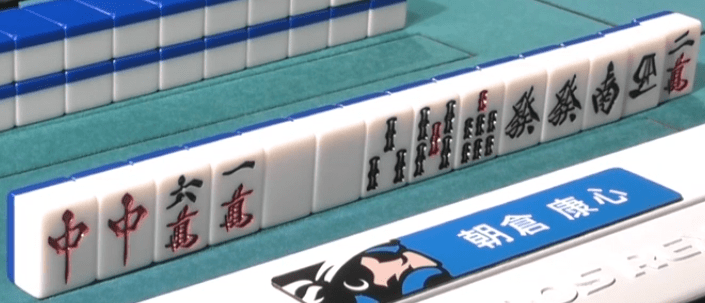
Tiles are tiles. What more can I say? Unfortunately, any tiles that have been called can’t be seen. You just have to remember them.
Discards
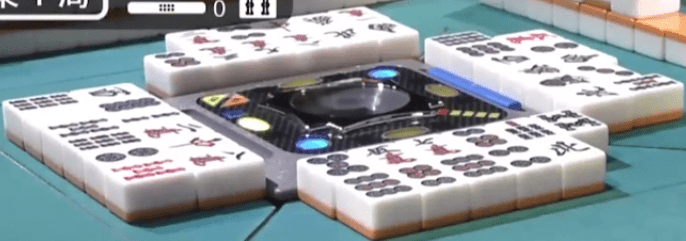
The discards are a bit difficult to see, but are visible nonetheless. You can see the riichi calls and all discards from the players across.
Nameplate
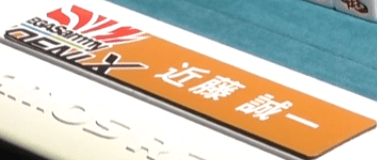
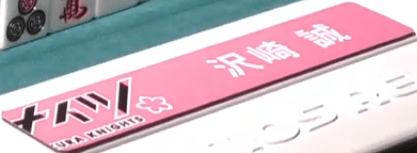
To identify which player is being shown, each player has a nameplate in front of them. On the nameplate is the player’s name and the team that they are a part of. You can match the player with their score by matching the colour or name on the nameplate with that shown on the bottom.
Bottom
Player and Score
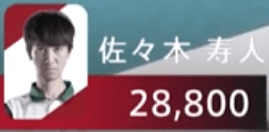
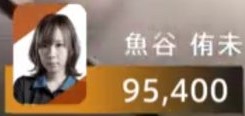
The name, face and score of each player is shown at the bottom, as well as the colour of the team that they represent (Yes, I know black is not a colour. And for those even pickier, I know pink is technically a tint and not a colour).
Colours
This is a list of colours and their corresponding teams:
- Black: EX Furinkazan
- Blue: U-Next Pirates
- Beige/Brown: Shibuya Abemas
- Green: Akasaka Drivens
- Orange: Sega Sammy Phoenix
- Pink: Kadokawa Sakura Knights
- Red: Konami Mahjong Fight Club
- Yellow: Team Raiden
You can also check the team names (in Japanese) in the top-right hand corner.
Names
Since the names are in Japanese, it may be difficult to figure out the player’s name. However, once you’ve identified the team, you can look through the list of that team’s players (in the dropdown menus at the top of the blog) and see which one matches.
Dealer
To identify the current dealer, look for the red underline. The order of dealers is determined by the order that the players are a the bottom. In short, the player in the 1st, 2nd, 3rd and 4th position will be the 1st, 2nd, 3rd and 4th dealer, respectively.
Riichi

If a player has called riichi, they will have a red/brown outline around the player.

The frame is not static, with the red line moving around often.
Point Exchanges
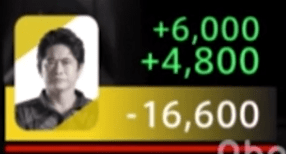
When a player wins, their point gain will be displayed above the player’s score. Occasionally, two numbers will be shown. If this is the case, the top number is the amount earned/lost from riichi sticks, while the bottom is the amount earned/lost from the winning hand + honba.
Team Score

Every so often, the bottom switches to a team score. The team score shows the ranking and the score of the team before the start of the game and doesn’t include the results of the current game.
Putting It All Together
Let’s go through a few examples to see how all this information comes together.
Example 1
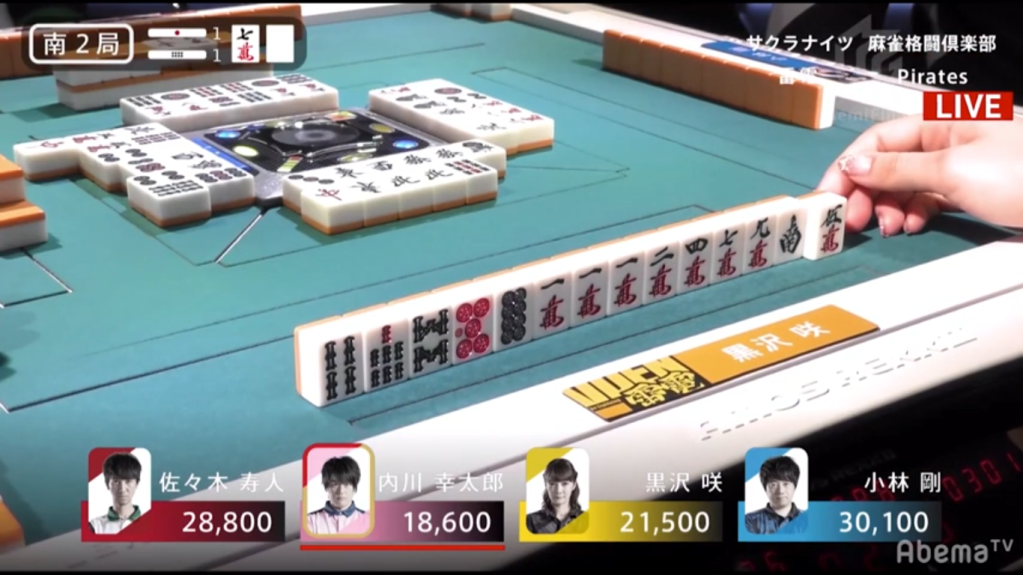
- Top Left
- South 2, 1 honba (S2-1)
- 1 riichi stick left over from the previous round
- 7m is the dora, White Dragon is the kandora
- Bottom
- Sasaki Hisato of Konami Mahjong Fight Club with 28,800 (2nd place)
- Uchikawa Kotaro of Kadokawa Sakura Knights with 18,600 (4th place)
- Also the dealer and has called riichi
- Kurosawa Saki of Team Raiden with 21,500 (3rd place)
- Kobayashi Go of U-Next Pirates with 30,100 (1st place)
- Play area
- Looking at Kurosawa’s hand (478s08p1112479m2z, 5m draw)
- Uchikawa called riichi in the middle of the 2nd row
- Kan of some sort by Uchikawa (upside-down tile on the bottom left of the screen)
- Kobayashi made a call of some sort
Example 2
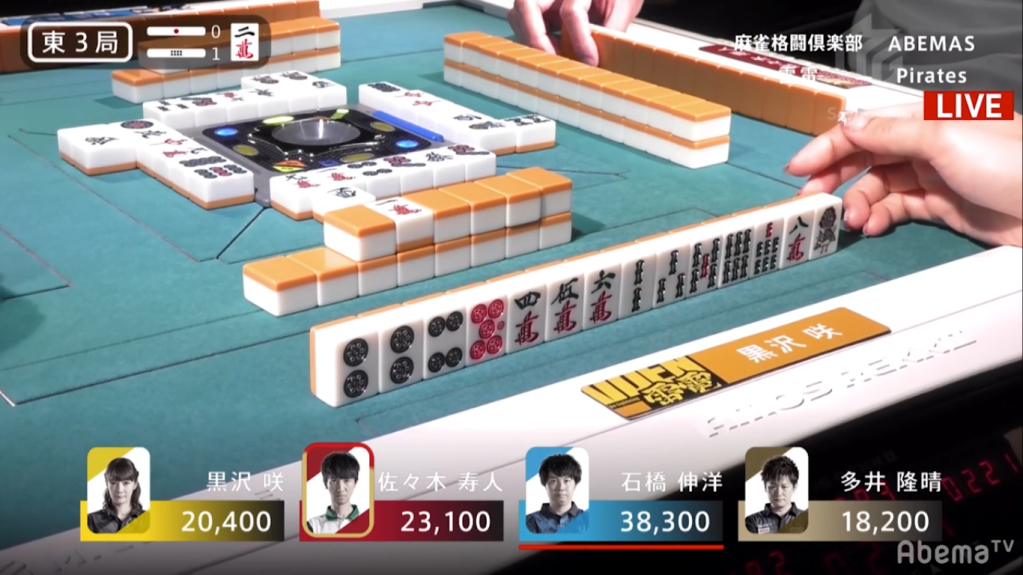
- Top Left
- East 3, 1 honba (E3-1)
- 2m is the dora
- Bottom
- Kurosawa Saki of Team Raiden with 20,400 (3rd place)
- Sasaki Hisato of Konami Mahjong Fight Club with 23,100 (2nd place)
- Has called riichi
- Ishibashi Nobuhiro of U-Next Pirates with 38,300 (1st place)
- Is the dealer
- Ooi Takaharu of Shibuya Abemas with 18,200 (4th place)
- Play area
- Looking at Kurosawa’s hand (2240p4568m23567s, 1s draw)
- Sasaki called riichi at the start of the 1st row
FAQ
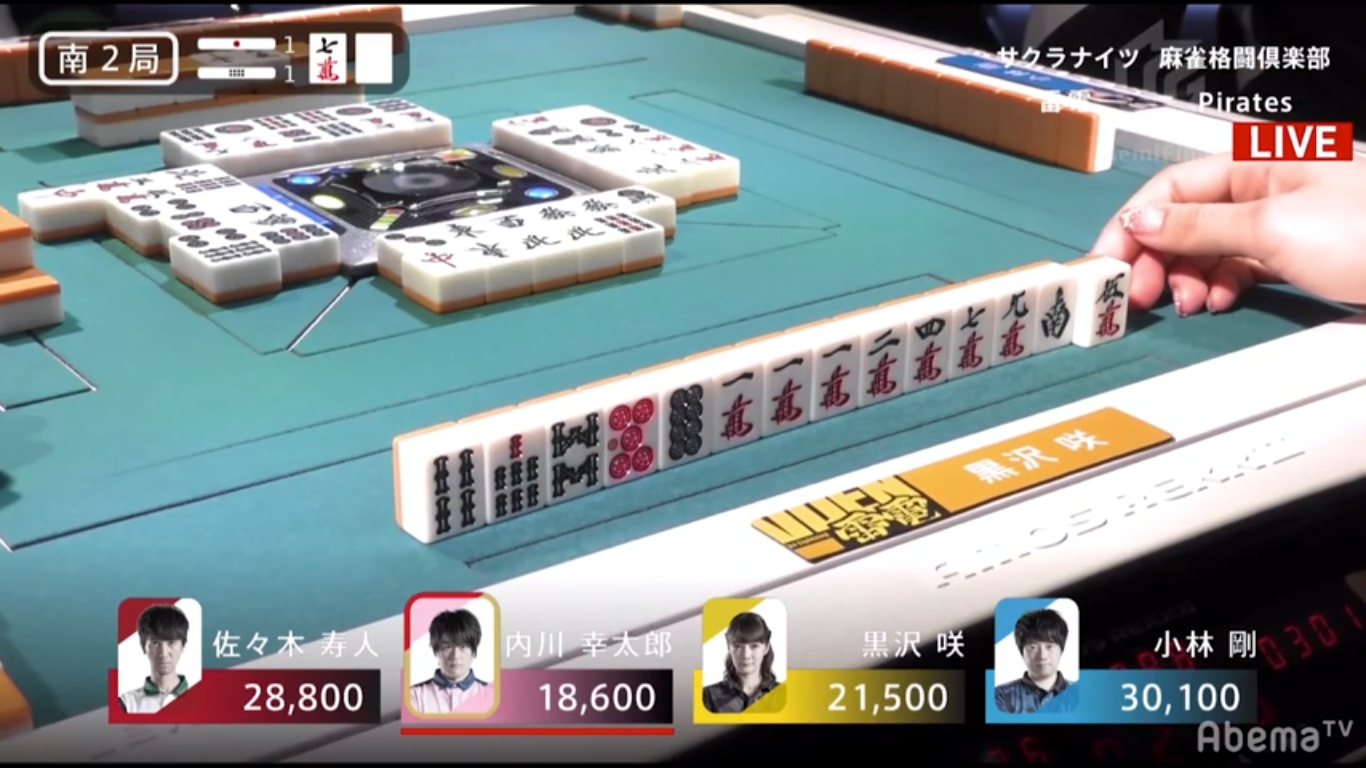
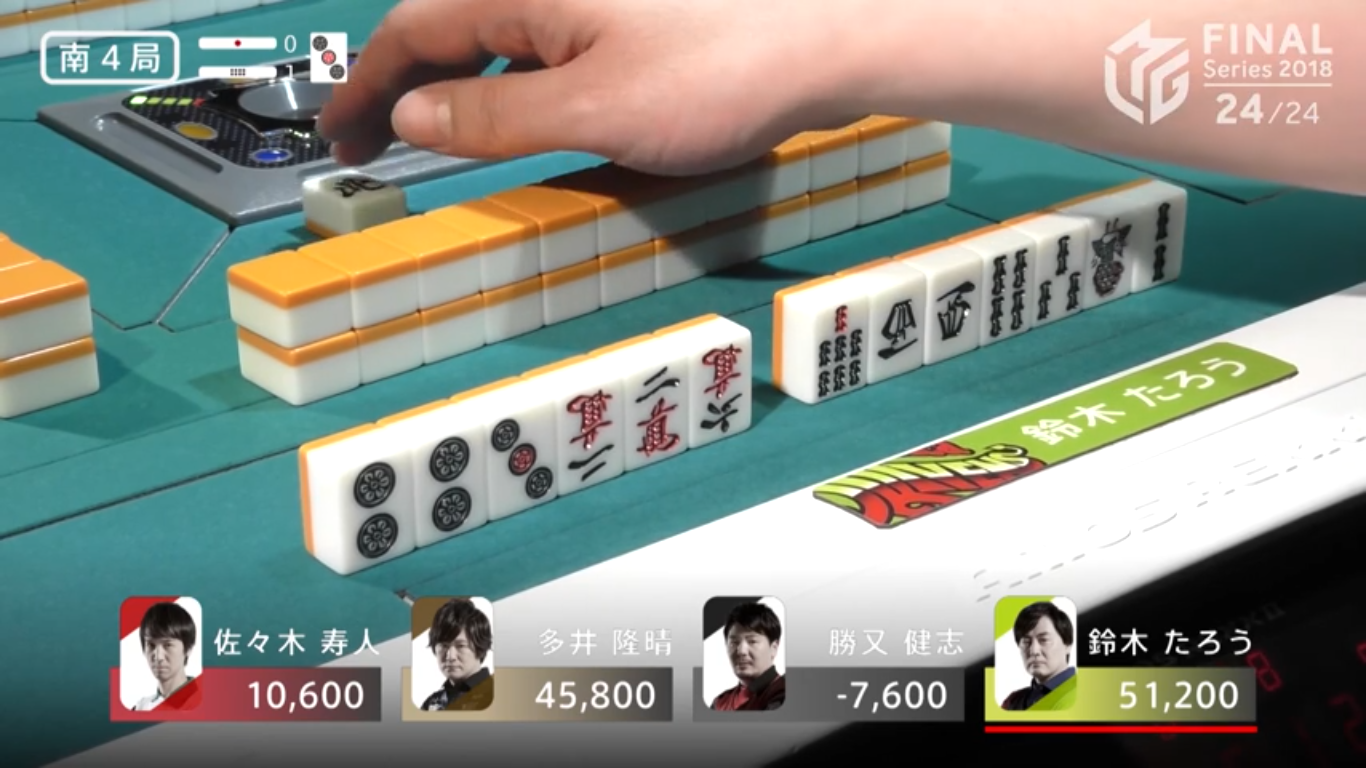
Was the layout always like this?
Nope. In the 2018 season, the top left corner didn’t have any dark shading behind it, so it was difficult to see. The players’ profiles were also different
How do I know the uradora?
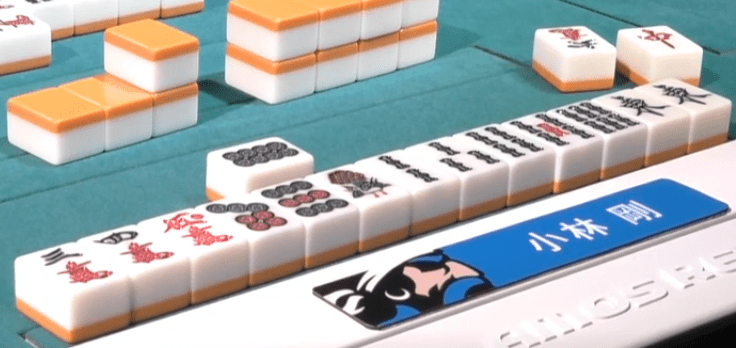
Unlike regular dora and kandora, the kandora isn’t shown on the top-left. In order to find out the uradora, you will have to watch the playing area. After a player wins while they are in riichi, they will usually take the winning tile first and then pick up the dora stack. They will then flip over the bottom tile, which is the uradora indicator. The tile after in order is the uradora, just like how the regular dora is determined
How do I know the calls?
Unfortunately, the calls aren’t visible, so you have to memorize the calls. Occasionally, the commentators will mention the calls, but this will be in Japanese (for example, “iisou pon” means a pon on the 1 of bamboo)
How do I know the yaku/hand score?
There are two ways to determine the yaku:
- Figure it out yourself.
- The commentators will list the yaku in Japanese and the hand value. For example, “Riichi, Pinfu, Tanyao, Dora. Hassen ten” means that the player won (using WRC terminology) Riichi/Pinfu/All Inside/Dora for 8000 points.
 M-League Watch